
How can I traverse an undirected tree using DFS or BFS in JavaScript?

In the previous article, we explored how to build an undirected tree from an array of edges in JavaScript. Now, let's look at how to traverse this tree using Depth-First Search (DFS) and Breadth-First Search (BFS) algorithms.

Undirected tree from edges
Learn how to build an undirected tree from an array of edges in JavaScript, with various approaches for storing node relationships.
Note that we'll be using the same tree as in the last article:
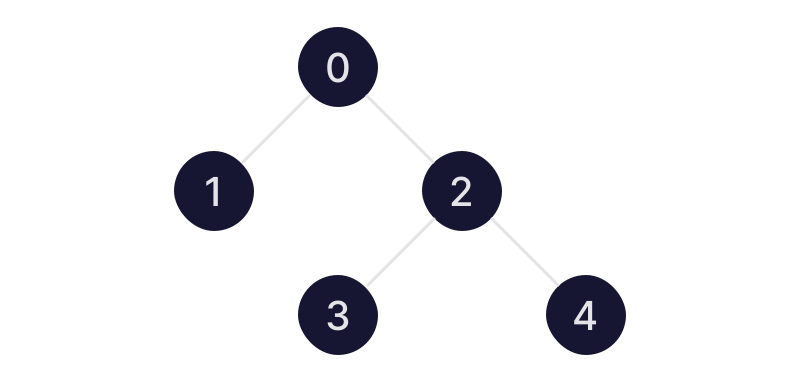
This tree would correspond to the following edges array and Map representation:
const edges = [ [0, 1], [0, 2], [2, 3], [2, 4] ];

const graphMap = new Map([
  [0, [1, 2]],
  [1, [0]],
  [2, [0, 3, 4]],
  [3, [2]],
  [4, [2]]
]);
Depth-First Search (DFS)
Depth-First Search (DFS) is a traversal algorithm that explores as far as possible along each branch before backtracking. DFS can be implemented recursively or iteratively, using an explicit stack. I find the iterative approach to be more efficient and easier to understand, so I'll focus on that here.

Stack
A stack is a linear data structure which follows a last in, first out (LIFO) order of operations.
const dfs = (graph, start, process) => {
  const stack = [start];
  const visited = new Set();

  while (stack.length) {
    const node = stack.pop();
    if (visited.has(node)) continue;

    visited.add(node);
    process(node);

    const neighbors = graph.get(node) || [];
    for (const neighbor of neighbors)
      if (!visited.has(neighbor)) stack.push(neighbor);
  }
};

dfs(graphMap, 0, node => console.log(node));
// LOGS: 0, 2, 4, 3, 1
This implementation uses a stack to keep track of the nodes to visit. It starts from the start node, processes it, and then pushes its unvisited neighbors onto the stack. The process continues until all reachable nodes are visited.
Breadth-First Search (BFS)
Breadth-First Search (BFS) is a traversal algorithm that explores all the neighbors of a node before moving on to the next level. It can be implemented using a queue.

Queue
A queue is a linear data structure which follows a first in, first out (FIFO) order of operations.
const bfs = (graph, start, process) => {
  const queue = [start];
  const visited = new Set();

  while (queue.length) {
    const node = queue.shift();
    if (visited.has(node)) continue;

    visited.add(node);
    process(node);

    const neighbors = graph.get(node) || [];
    for (const neighbor of neighbors)
      if (!visited.has(neighbor)) queue.push(neighbor);
  }
};

bfs(graphMap, 0, node => console.log(node));
// LOGS: 0, 1, 2, 3, 4
This implementation uses a queue to keep track of the nodes to visit. It starts from the start node, processes it, and then adds its unvisited neighbors to the queue. The process continues until all reachable nodes are visited.
Conclusion
Both DFS and BFS are powerful algorithms for traversing trees and graphs. The choice between them depends on the specific requirements of your application. DFS is often more memory-efficient for deep trees, while BFS is better for finding the shortest path in unweighted graphs. I hope you enjoyed this article and that it will help you in your JavaScript journey! ⛵